

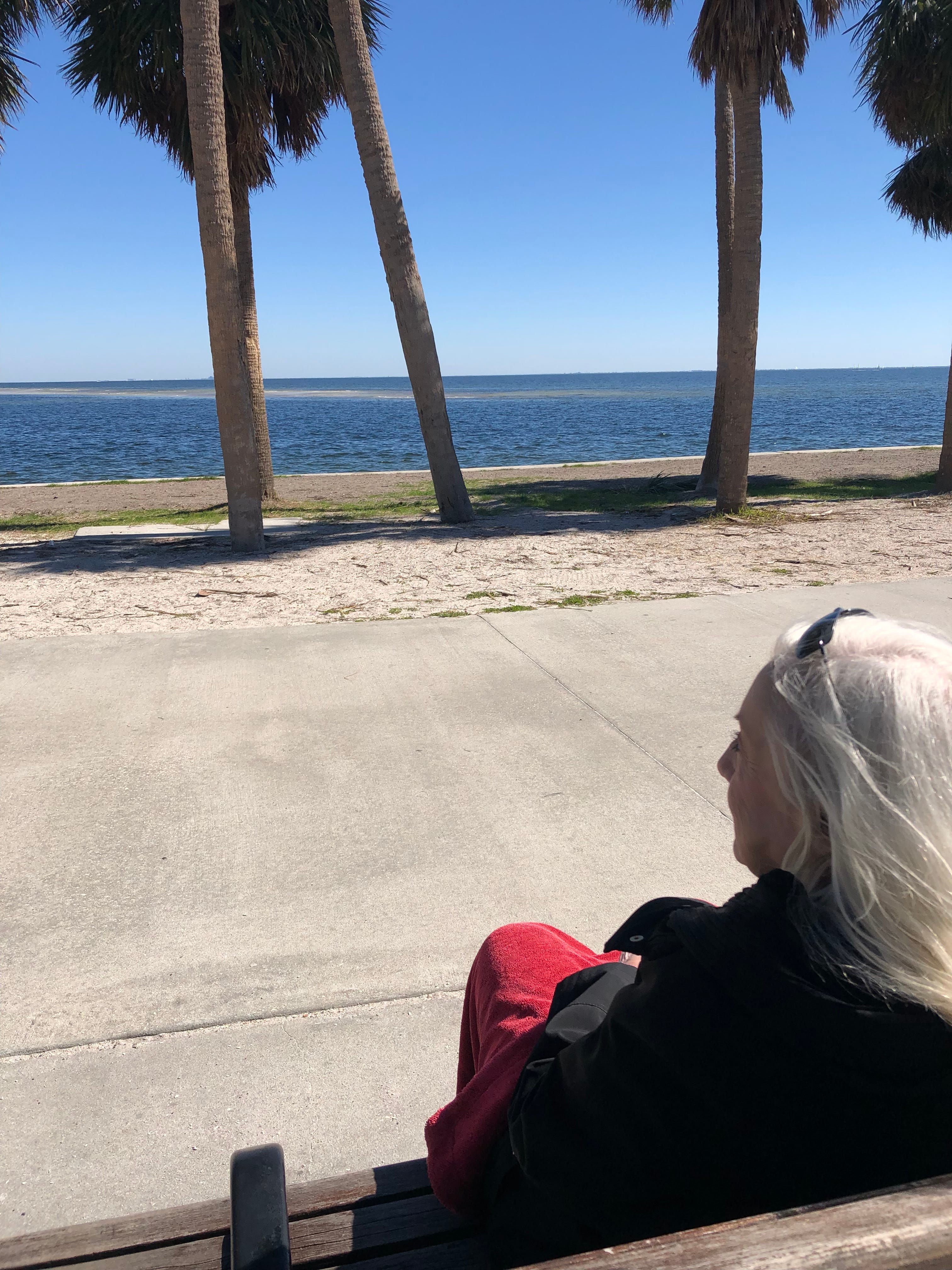
Gazing out on Tampa Bay in St. Petersburg.
The person you present to the world may be real. It may contain the core of who you are. And the way you present yourself may also leave out major pieces of who you are now.
For much of my working life, I knew how I wanted people to see me.
Professional. Poised. Intelligent. Caring. Knowledgeable. A good listener and a problem solver. Someone they could trust with their story and potential solutions to their problems.
I wanted people to feel comfortable telling me their stories, even when we were strangers waiting for a dinner reservation or sitting in a doctor’s waiting room. And they often did.
Over fifty-five years of consulting and training, I became accustomed to being the person who listened, asked questions, and helped others find a way forward.
Those qualities are mine. I value them. I also spent years practicing how to bring them into a room in a way that made people confident that I could help.
In fact, an early client once asked me why I brought so much power into the room. I asked what they meant. Their response made me evaluate how I show up. To understand it and make sense of it.
They said I took up space, spread my things out, and created a presence the group knew they would need to reckon with. I realized the presence I brought helped me establish myself as a consultant they could trust and rely on.
I used this insight for years to help clients learn how to build a stronger presence in their own rooms.
Recently, I’ve wondered what happens when we become so familiar with one way of presenting ourselves that we portray only that aspect of our personality.
In this phase of my life, bringing power into a room does not achieve what I need now. It’s one part of me, the helper, problem solver, and purveyor of information.
Who do people know? And who might we want them to know now?
The person we learned to present in one phase of our lives may remain part of us but may not be all of who we are today.
Maybe I can let people know the quieter, thoughtful, friendship-seeking parts of me that have no need to be in charge or make progress, just being in this new world without my husband Bill and daily work.
The Persona We Display
Earlier, I wrote about the personas we develop: the ways we present ourselves to meet expectations, succeed at work, or find our place with other people.
I described a persona as a kind of mask. Looking back, I think that was too simple.
The confident consultant may also be uncertain. The funny friend may be grieving. The person who takes care of everyone may sometimes need care herself.
None of those qualities has to be an act. They can all belong to the same person.
We choose what parts of ourselves to share in various situations for good reasons. A workplace conversation may call for different things than a conversation with a close friend. Some experiences are private. Some people haven’t earned our trust.
Being authentic doesn’t require us to tell everyone everything. It does ask us to notice whether the way we present ourselves still fits, and whether it makes room for the relationships we want.
When the familiar role follows us into different phases of our lives, we need to examine whether it fits our current needs and goals. It may not.
Think about the role you’ve played in your family, at work, or among friends.
Perhaps you’re the dependable one. People come to you because you’ll know what to do.
Maybe you’re the cheerful friend who can lighten a difficult gathering. Or the person who listens while everyone else talks.
These roles may reflect strengths you’re proud of. They may also become so familiar that other people don’t think to look beyond them to who you’ve become in a different phase.
Looking Beyond the Known Person
If you’re always the one who organizes the gathering, does anyone know you’d welcome an invitation?
If you’re known for handling matters yourself, would your friends know when you could use help?
If you’re the listener, do you give yourself room to tell someone what’s on your mind?
The answers aren’t always comfortable. People may have grown accustomed to a pattern we helped establish.
They may also be delighted to discover that we’d like something different.
But we can’t expect them to know what we never express. We also won’t want to bare our soul to everyone.
We can find the space between these extremes.
Who Are You Now?
Life changes the circumstances in which our familiar identities developed. Work ends or changes. Children grow up. We move. A relationship ends. Someone we love dies.
The person who could fill a room with conversation at work may discover that meeting people outside of the office requires something different. The person who is accustomed to doing everything with a partner may have to decide what to do alone—and when to ask someone to come along.
I’ve been thinking about this since Bill died.
I do well alone. I value solitude, and much of my writing and thinking happens in my solitary moments by my lake or in my forest. But I also miss the easy familiarity of being expected somewhere, of having people with whom making a plan feels natural.
For years, much of my contact with people came through work. Now, if I want to build different relationships, I have to give creating them some attention.
That doesn’t mean becoming a person who loves crowded rooms and lots going on. That will never be me.
But it does mean accepting an invitation I might once have declined, telling someone I’d enjoy seeing them again, or letting a neighbor know her company matters to me.
Small disclosures can make an opening. So can repeated time together.
Feeling Vulnerable: Sharing More of Who We Are
At a recent conference about connections, restaurateur Will Guidara talked about offering a small piece of vulnerability before asking another person to open up.
This idea is meaningful to me.
We can begin offering something modest and true: “I’m happy to be here, although I was a little nervous about coming.” Or, “I’ve been missing our conversations. Perhaps we can get together next week.” Or, “We seem to have that interest in common. Why don’t you come over for coffee and we can talk more?”
The other person is free to respond as they wish, but we’re opening up and giving them an opening to know us.
We Don’t Need to Leave All of Us Behind
Sometimes we discover that a role we’ve carried still fits. Sometimes we find we’re ready to let parts of it go. And sometimes another person sees something in us we’ve nearly forgotten—or never noticed at all.
The question I asked in 2024 about who I bring into an interaction still interests me: How can I bring more of my true self into this moment? My now self?
Today, I would add another question: Who am I hoping will get to know me?
In the coming weeks, I want to explore how we find belonging and make or maintain friendships as our lives change. I suspect the answers will be different for each of us.
But they may begin with making a little room to be the person we are now.

Continue the Conversation
I’m learning that the person who once needed to bring power into a room can also make room for quieter parts of herself—and let others get to know them.
Is there a role people know you for? Does it still fit—and is there another part of you you’d like to bring forward?
I’d love to hear as much of your story as you feel comfortable sharing in the comments.
In the coming weeks, I’ll explore how we find belonging and make or maintain friendships as our lives change.
I also continue these conversations in Substack Notes, where I share the smaller observations and questions that often become future ValuesCrafting essays.
What kind of world do you want to live in?
ValuesCrafting begins with the belief that every person matters and that our ordinary choices help create the world we share.
Live what you believe. Create the world you want to live in.